The Business Researcher Newsletter
April 18, 2005 Volume 8 Number 3
NB: This newsletter is sent out only to those who have requested it.
If someone has submitted your e-mail address to us without your permission, please send us an e-mail indicating you would like to unsubscribe at:
Hello,
Welcome to the Spring issue of the BR Newsletter.
There are a few data updates to report in this issue. First of all, December 2004 business counts have been release by Statistics Canada. This means that our Canadian Industry Profiles are now updated with December 2004 business count information.
Statistics Canada has also released the latest issue of Annual Demographics Statistics. This publication contains the latest official population estimates by age and sex. Data is provided for Canada, the provinces, territories, census divisions and census metropolitan areas and economic regions. Estimates by age, sex and marital status and for census families are also included for the provinces and territories.
In addition to the publication, this product also includes a CD-ROM with historical data by various levels of geography. This data can be easily exported into any spread sheet program to create custom demographic tables or to calculate per-capita rates for market research, quantitative analysis and planning.
If you require current, reliable and accurate population data, Annual Demographic Statistics is THE source to turn to. GDSourcing is offering a 20% discount off the cover price. For more information or to order please see: https://gdsourcing.com/AnnualDemographicStatistics.htm.
Finally the Industry Canada Performance Plus profiles have been updated to include 2002 data. Please see the article below for more information on this resource.
I hope you find this issue helpful.
John White
GDSourcing - Research & Retrieval
What's New at www.gdsourcing.ca - Trucks, Computers, ISPs & Trust
The following site summaries were added to the GDSourcing web site over the last 6 weeks.
Today's Trucking
Site: http://www.todaystrucking.com/
Site Summary: https://gdsourcing.com/works/Trucking.htm
Retail truck sales by class, top trucking companies in Canada
Canadian Association of Internet Providers
Site: http://.94/caip/
Site Summary: http://www.cata.ca/caip/resources/industrystats/
Data on ISPs in Canada
Computer Industry Almanac
Site: http://www.c-i-a.com/
Site Summary: http://www.gdsourcing.ca/works/Almanac.htm
Number of PCs in use in Canada, Internet use
Edelman
Site: http://www.edelman.com/
Site Summary: https://gdsourcing.com/works/Edelman.htm
Annual Global Trust Barometer
The following statistics were released by Statistics Canada over the last 6 weeks. We have listed those releases we feel are of the most interest to Canadian entrepreneurs.
Very few of these statistics are available on-line. The URL listed is a direct link to the press release associated with the data. It provides contact and ordering information. If you want to purchase any publication related to these releases please see our web site: https://gdsourcing.com/works/StatCan.htm
We offer a 20% discount on most Stats Can publications and a 10% discount on Stats Can electronic products. For more information you can reach us at . Put "StatsCan" in the subject line of your e-mail.
AGRICULTURE
Poultry and Egg Statistics, 2004
http://www.statcan.ca:8096/bsolc/english/bsolc?catno=23-015-XIE
Study: High-tech vegetables: The booming greenhouse vegetable industry 1990 to 2004
http://www.statcan.ca/Daily/English/050322/d050322e.htm
Farm Environmental Management in Canada: Grazing Management in Canada, 2001
http://www.statcan.ca:8096/bsolc/english/bsolc?catno=21-021-MIE2005001
Farm operating revenues and expenses 2003 (final estimates)
http://www.statcan.ca/Daily/English/050406/d050406b.htm
Total income of farm families 2002
http://www.statcan.ca/Daily/English/050404/d050404b.htm
ARTS & CULTURE
Television viewing Fall 2003
http://www.statcan.ca/Daily/English/050331/d050331b.htm
International trade in culture goods 2003
http://www.statcan.ca/Daily/English/050329/d050329b.htm
BUSINESS SERVICES
Consulting Engineering Services Price Index 2003 (preliminary)
http://www.statcan.ca/Daily/English/050315/d050315f.htm
Industrial research and development characteristics 1994 to 2004
http://www.statcan.ca/Daily/English/050323/d050323e.htm
Accounting services price indexes 2002 and 2003
http://www.statcan.ca/Daily/English/050407/d050407c.htm
Annual Survey of Commercial and Industrial Machinery and Equipment Rental and Leasing 2003
http://www.statcan.ca/Daily/English/050331/d050331c.htm
Legal aid: Resource and caseload 2003/04
http://www.statcan.ca/Daily/English/050329/d050329d.htm
CONSTRUCTION AND REAL ESTATE
Residential construction investment 2004 and fourth quarter 2004
http://www.statcan.ca/Daily/English/050301/d050301b.htm
Investment in non-residential building Fourth quarter 2004 (revised)
http://www.statcan.ca/Daily/English/050301/d050301c.htm
National Tenant Satisfaction Survey 2004
http://www.statcan.ca/Daily/English/050315/d050315e.htm
Real estate rental and leasing and property management industries 2003
http://www.statcan.ca/Daily/English/050318/d050318d.htm
Flows and stocks of fixed residential capital 2004
http://www.statcan.ca/Daily/English/050407/d050407d.htm
ECONOMIC INDICATORS
Study: Profitability of Canadian-controlled enterprises compared with US-controlled enterprises 1990 to 1998
http://www.statcan.ca/Daily/English/050303/d050303a.htm
Labour productivity, hourly compensation and unit labour cost 2004 and fourth quarter 2004
http://www.statcan.ca/Daily/English/050310/d050310a.htm
Industrial capacity utilization rates Fourth quarter 2004
http://www.statcan.ca/Daily/English/050310/d050310b.htm
Study: Canadian direct investment in offshore financial centers 1990 to 2003
http://www.statcan.ca/Daily/English/050314/d050314b.htm
Canada's international investment position Fourth quarter 2004
http://www.statcan.ca/Daily/English/050316/d050316a.htm
National balance sheet accounts Fourth quarter, 2004
http://www.statcan.ca/Daily/English/050317/d050317a.htm
Study: Recent changes in the labour market 1991 to 2004
http://www.statcan.ca/Daily/English/050318/d050318a.htm
Study: Household spending and debt 1982 and 2001
http://www.statcan.ca/Daily/English/050322/d050322c.htm
Study: The relationship between property tax and income 2001
http://www.statcan.ca/Daily/English/050322/d050322d.htm
Canadian Business Patterns December 2004
http://www.statcan.ca/Daily/English/050407/d050407e.htm
EDUCATION
Education Price Index 2002 and 2003
http://www.statcan.ca/Daily/English/050311/d050311c.htm
Study: Is postsecondary access more equitable in Canada or the United States? 2001
http://www.statcan.ca/Daily/English/050315/d050315c.htm
HEALTH
Health Reports: Use of alternative health care 2003
http://www.statcan.ca/Daily/English/050315/d050315b.htm
National Population Health Survey — Obesity: A growing issue 1994/95 to 2002/03
http://www.statcan.ca/Daily/English/050407/d050407a.htm
HOSPITALITY
Food services and drinking places 2003
http://www.statcan.ca/Daily/English/050317/d050317e.htm
National tourism indicators 2004 and fourth quarter 2004
http://www.statcan.ca/Daily/English/050329/d050329a.htm
INFORMATION TECHNOLOGY
Study: The information and communications technology sector through the boom and bust years 1997 to 2003
http://www.statcan.ca/Daily/English/050302/d050302a.htm
MANUFACTURING
Study: The textile and clothing industries 1992 to 2004
http://www.statcan.ca/Daily/English/050321/d050321b.htm
Annual Survey of Manufactures 2003
http://www.statcan.ca/Daily/English/050404/d050404e.htm
MARKET - DEMOGRAPHICS
Study: Becoming Canadian 2001
http://www.statcan.ca/Daily/English/050308/d050308a.htm
Divorces 2003
http://www.statcan.ca/Daily/English/050309/d050309b.htm
Study: Canada's visible minority population in 2017
http://www.statcan.ca/Daily/English/050322/d050322b.htm
Annual demographic statistics 2004
http://www.statcan.ca/Daily/English/050331/b050331a.htm
Demographic statistics January 1, 2005 (preliminary)
http://www.statcan.ca/Daily/English/050324/d050324c.htm
NON-PROFIT
Summary of the Findings of the National Survey of Nonprofit and Voluntary Organizations, 2003 revised
http://www.statcan.ca:8096/bsolc/english/bsolc?catno=61-533-SIE
OTHER SERVICES
Personal services industry 2003
http://www.statcan.ca/Daily/English/050318/d050318c.htm
PRIMARY
Coal mining 2003
http://www.statcan.ca/Daily/English/050302/d050302d.htm
Electric power generation, transmission and distribution 2003
http://www.statcan.ca/Daily/English/050316/d050316e.htm
Study: A regional perspective on energy consumption in Canada 1990 to 2003
http://www.statcan.ca/Daily/English/050323/d050323c.htm
TRADE
Annual retail trade 2003
http://www.statcan.ca/Daily/English/050330/d050330b.htm
Non-store retailers 2003
http://www.statcan.ca/Daily/English/050330/d050330c.htm
Annual wholesale trade 2003
http://www.statcan.ca/Daily/English/050324/d050324a.htm
Study: The effect of the Canada-US Free Trade Agreement on product diversification in Canadian manufacturing plants 1980 to 1997
http://www.statcan.ca/Daily/English/050324/d050324b.htm
TRANSPORTATION
Railway carloadings 2004 and December 2004
http://www.statcan.ca/Daily/English/050303/d050303c.htm
Small for-hire motor carriers of freight and owner operators 2002
http://www.statcan.ca/Daily/English/050314/d050314c.htm
Road motor vehicle registrations 2004 (preliminary)
http://www.statcan.ca/Daily/English/050315/d050315d.htm
For-hire motor carriers of freight, top carriers Fourth quarter 2004
http://www.statcan.ca/Daily/English/050316/d050316c.htm
Canadian passenger bus and urban transit industries 2003 (preliminary)
http://www.statcan.ca/Daily/English/050316/d050316b.htm
Travel arrangement services
http://www.statcan.ca/Daily/English/050323/d050323d.htm2003
Automotive equipment rental and leasing 2003
http://www.statcan.ca/Daily/English/050401/d050401a.htm
Port activity 2003
http://www.statcan.ca/Daily/English/050404/d050404a.htm
Traveller accommodation 2003 (preliminary)
http://www.statcan.ca/Daily/English/050404/d050404d.htm
Rail transportation 2003 (preliminary)
http://www.statcan.ca/Daily/English/050405/d050405b.htm
Taxi and limousine service industry 2003 (preliminary)
http://www.statcan.ca/Daily/English/050407/d050407b.htm
The personal and household service industry of Canada has grown rapidly over the last ten years. Time has become a premium for many families so they are willing to hire someone to get things done. The majority of these new consumer services are very specific (e.g. dog walking, professional organizer) and consequently there is very little (if any) industry specific data available.
For a general overview of this sector Statistics Canada publishes data on the Personal services industry. This broad heading includes everything from pet training services to personal shopping, from party planning to estheticians. The latest (2003) highlights for the sector can be found at the Statistics Canada web site: http://www.statcan.ca/Daily/English/050318/d050318c.htm This includes basic performance data such as total revenue and operating expenses.
The Daily link above also includes access to the related CANSIM tables (see bottom of release). These tables provide the same data at a more detailed industry level. There is a charge of $3 per time series for this data.
You can also access greater industry detail through either GDSourcing's Canadian Industry Profiles (http://www.gdsourcing.ca/SBDC.htm) and/or Industry Canada's Performance Plus database (http://www.sme.ic.gc.ca). Both provide more financial benchmarks than the basic Statistics Canada figures above. For more established businesses you will find a heading that exactly matches your line of business (e.g. 812320 Dry Cleaning & Laundry Services) However most personal service entrepreneurs will find their business is part of the larger more generic industry heading: NAICS 812990 Other Personal Services.
For these types of businesses you will need to rely heavily on media articles and reports. Use a periodical database. You can access one at most public libraries. Search on keywords related to the your service and its benefits. Also search on business specific "lingo". For example many home services that provide assistance with errands and chores are referred to a "personal concierge services".
In an ideal world your media search will uncover articles which describe your target market and identify marketing challenges of key businesses in your industry. In more cases than not however you will have to glean the required information from a variety of articles and combine these insights with your own observations and market expectations. In other words you will need to develop your own target market profile. To do this consider who will benefit the most from your service and more importantly who will recognize its value.
Normally we recommend that researchers ensure their information is strictly Canadian. For this sector however, we encourage researchers to look at U.S. periodicals as well. Many of the most innovative home services originated in the U.S. before they appeared in the Canadian marketplace. Use the experience of U.S. companies to ensure the success of your own operations in Canada.
Keep in mind when you are using American information that if you are planning on providing a service that is yet unknown in Canada, you will need to educate your market as to the benefits of your service. Many entrepreneurs are excited by the idea of being "the first" to offer a particular service and are surprised when they have difficulty finding customers.
Remember, it is often easier to attract a portion of an existing market than to develop a new one from scratch. With a new market you must convince people to spend money on something they have never even considered purchasing before. You need to demonstrate the benefit and convince them of the value. With an existing market, customers already recognize the value and the benefit and only need to be shown that your company will meet their needs the best.
Once you have developed a profile of your "best customer", you will need to determine how many are located in your local market. The characteristics of a local market can be found using 2001 Census data. Most major libraries now have Census publications with Census Tract data (urban neighborhoods). You can also use the publication FP Markets - Canadian Demographics for information at a city or town level.
Another helpful source is SuperDemographics (http://www.superdemographics.com). This site lets you identify the Lifestyle population groups within a 0.1km to 10km radius of a specific postal code. An example of a lifestyle group is:
Cluster A: Top Gun Metro.(2.98% of Canadian households)
Top lifestyle, in management, the social sciences, education, government and as business owners (2X average). Average income: $129,200; home value $389,000. Average maintainers’ age, 50, household size 3.1. 75% are English speaking, preferring Toronto, Calgary and Ottawa. With more than 15 years of education, they spend 4X average on education, and investments. They travel 3 times the average, golf, ski and play soccer. They have worldly reading habits.
For a fee the SuperDemographics web site also lets you access other local data on spending patterns and Census demographics.
Local governments can also be helpful in profiling neighborhoods or providing by-law specific information such as numbers of dog licenses.
Beyond media sources and local demographics look for related organizations and associations. There are groups you can contact for even the most specific personal service businesses. Some can be found in the publication Associations Canada (available in most major libraries). Others can be located by searching Google. Search on your line of business in quotation marks and add the word association. (e.g. "dog walking" +association found the Professional Dog Walkers Association: http://www.prodogwalker.com/) These organizations may or may not have any industry data. However all of them should be able to offer advice on business set up, industry issues and market growth.
If you have competition active in your market place use them as an information resource. First determine how they advertise in your market. Are they listed in the Yellow Pages? What business heading are they identified under? What services or qualities do they highlight in their ads? This will help you to assess their marketing strategy. It will also help you to identify other competitors in your market (i.e. other companies listed under the same Yellow Page heading.)
It is always difficult to assess the market size for most personal services because they are not included in retail trade surveys and most of the spending categories in the Statistics Canada Survey of Household Spending are too broad. To view available categories see: http://www.gdsourcing.ca/Categories.htm
One way to get a rough estimate of market size is to use a business directory which includes revenue size information. Business directories usually provide more industry sub-headings than you find in standard industry benchmark surveys and often cover very specific personal services. If you use the directory on the GDSourcing site you can access individual company information free of charge. (http://www.gdsourcing.ca/CdnDir.htm) All you need to know is the full postal code of your competitor. You can get this from the Yellow Pages online (http://www.yellowpages.ca) or by using Canada Post's Postal Code Look-up Tool (http://www.canadapost.ca/tools/pcl/bin/advanced-e.asp)
Simply enter one postal code along with your line of business in the search criteria. (Use the keyword search or the SIC code look-up feature). Your results list should identify only one business (the competitor in question). If you click on the "preview list" icon you can then see the revenue details of this listing. Clearly this can be a time consuming process if you have a number of competitors. Depending on your time-constraints you may find it more efficient to purchase the entire list of your competitors outright. If you have difficult determining who your competitors are or in downloading a list, please contact us at .
Once you have the sales estimates of all your competitors, simply total the figures to arrive at a market size. These sales figures should only be used as rough a guide to local competitor performance. They are based on self-reported sales volumes and InfoUSA estimates. Use them to identify sales ranges and to determine your biggest competitors. Do not consider them as actual sales volumes or an exact market size measure.
Finally do not forget to speak to people directly in your market and in your industry (e.g. suppliers). Oftentimes this is the best and in some cases the only way to understand the true nature of a personal services market and business. Also make sure you talk to the first customers who actually purchase from you. As your "first" they likely represent the best customers of your entire target market. Find out how they discovered your business and why they chose to hire you.
Personal/household services businesses are unique as the people operating them. While this makes the sector an exciting one to participating it, it also makes it a very challenging one to research. More so than any other business, it requires your own analytical abilities to stitch together resources. Do not give up if your initial research efforts are fruitless. Redouble your efforts and perhaps take a different approach (e.g. research other types of competitors, use alternate words and phrases in your periodical searches). Persistence is the key to researching this sector.
The Industry Canada Performance Plus database has been updated to now include 2002 data (http://sme.ic.gc.ca/). This database provides small business (less than $5 million in revenue) financial benchmarks by province and by specific industries (5 digit NAICS) for both incorporated and unincorporated businesses. It is an easy and free way to quickly assess industry performance. The source for this database is Statistics Canada's Small Business Profiles which in turn are based on business tax returns as well as a sample survey.
Each industry profile includes a balance sheet and income statement. This data is then subdivided into revenue size groupings so that you can then view performance data for all small businesses in your sector or for only the smallest. These financial benchmarks allow you to assess standard industry performance and provide a reliable baseline against which to develop your own cash flow projections.
In addition to using this data as a benchmark tool it is also an excellent resource for initiating contact with someone in your industry. Many business owners do not even know this information exists. Ask them to comment on the data to see if they think the figures are relevant and reasonable for your sector. If they do not think they are, ask them what seems the most out of line? Find out why it does not match their own experience? Make sure you have an extra copy you can leave with your contact. People tend to be much more helpful when they recognize a benefit in return for their time.
If you are looking to market to small businesses, you can also use this data to assess market potential, market size and to identify sectors more likely to be interested in your product/service. For example if you are selling marketing services or tools to small businesses you may want to compare a variety of small business sectors to determine who typically spends the most on advertising. (e.g. Lawyers typically spend $4000 a year, while Full Service Restaurants spend $10,700 and Funeral Homes spend $13,900). You can then use this information to direct your marketing efforts or tailor your service offerings.
As a rough guide of small business market size you can also multiply the average expenditure dollar amount for all businesses (incorporated and unincorporated) by the number of small businesses in your market. Use our Business Directory (http://www.gdsourcing.ca/CdnDir.htm) to get free local business counts. Make sure your search criteria limits your results to small businesses (with less than $5 million revenue). This market estimate should be used only as rough guide.
When you are first creating your Performance Plus Profile you have the choice of viewing the data in thousands of dollars or as a percentage of revenue. Given the fact that the data is from 2002, we recommend that researchers use the percentage of revenue figures. That way the effect of inflation will be minimized. Of course if you are more comfortable looking at actual dollar amounts or are trying to estimate market size select the dollar option.
In addition to how the data is displayed you can also choose the type of businesses you wish to examine. You have the choice of “All Businesses”, “Incorporated Businesses” or “Unincorporated Businesses”. Look at all three tables since slightly different data is presented in each.
Once you have selected your province, business type, data type and industry, click on "create report" to view your profile. Across the top of the your profile table you will see that the revenue ranges of each column are presented in $000s. This means you will need to add three zeros to each of the figures. The first column provides data for all small businesses in your industry (less than $5 million). The next two columns divide the industry into two revenue-size groupings and provide data for businesses in the upper and lower half. The next four columns then divide the industry into four revenue size groupings (quartiles). The last column identifies the percentage of business in the industry that reported each variable.
Some of the more insightful variables in this database include:
-
Advertising expenditures (what does a business in your industry typically spend on advertising)
-
Rent
-
Cost of goods sold
-
Number of employees (what size of workforce is most common for your type of businesses)
-
Accounts Receivable in Days (how long does it take you to get paid. This data is vital for organizing your cash flow. In some industries 90 days is the norm. If you are not prepared for that kind of time lag in income, it could prove disastrous.)
-
Percentage of businesses profitable and average profit earned
-
Percentage of businesses not profitable and average loss
It is great to see that this useful resource now contains the most current information from Statistics Canada. Make sure you employ this data in your research.
Each Business Researcher Newsletter ends with a collection of five statistics related to Canadian small businesses.
1. What % of self-employed businesses in Canada have paid help?
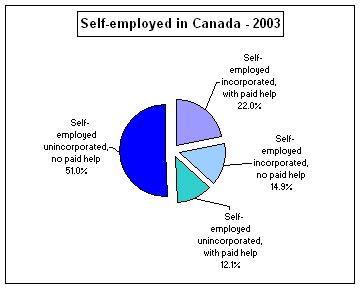
Source: Statistics Canada (2004)
2. What % of self-employed businesses in Canada are service producing?
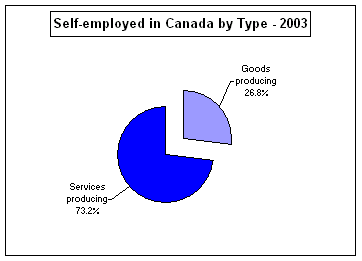
Source: Statistics Canada (2004)
3. Which is growing faster: the number of employees in Canada or the number of self-employed?
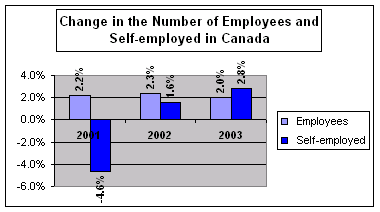
Source: Statistics Canada (2004)
4. What % of Canadian home-based businesses had Internet access in 2002?
24%
Source: POLLARA (Mar 2002)
5. In 2002 what % of Canadian small businesses (less than $5 million revenue) were profitable?
68.2%
Source: Industry Canada - Performance Plus (2004)
G D S O U R C I N G - R E S E A R C H & R E T R I E V A L
* gdsourcing.com * *
Copyright 2000, 2001, 2002, 2003, 2004, 2005 GDSourcing - Research & Retrieval. All rights reserved. You may circulate this newsletter freely as long as GDSourcing is clearly credited as the source. We encourage people to subscribe directly. There is no charge for this newsletter. A subscription form is available at http://www.gdsourcing.ca/newsletter.htm